Showing posts with label dual. Show all posts

Wednesday, December 18, 2013

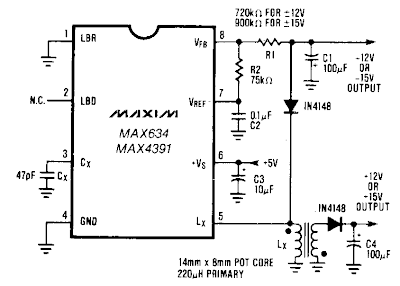
Dual Output dc dc Converter Circuit Diagram

The Dual Output dc-dc Converter Circuit Diagram buck-boost configuration the MAX634 is well suited for dual output dc-dc converters. Only a second winding on the inductor is needed. Typically, this second winding is bifilar-primary and secondary are wound simultaneously using two wires in parallel. 

The inductor core is usually a toroid or a pot core. The negative output voltage is fully regulated by the MAX634. The positive voltage is semi-regulated, and will vary slightly with load changes on either the positive or negative outputs.

Dual Output dc-dc Converter Circuit Diagram

Dual Output dc-dc Converter Circuit Diagram

Read More..

Tuesday, October 8, 2013

Dual Opamp Buffered Power Supply

There will be instances where the currents from each supply will be unequal. Where this is the case, the resistor divider is not sufficient, and the +ve and -ve voltages will be unequal. By using a cheap opamp (such as a uA741), a DC imbalance between supplies of up to about 15mA will not cause a problem. However, we can do better with a dual opamp (which will cost the same or less anyway), and increase the capability for up to about 30mA of difference between the two supplies.
Dual Opamp Buffered Power Supply
Read More..

Monday, September 30, 2013

Low Cost Dual Digital Dice

This simple dual digital dice is based on three low-cost ICs, a few transistors and a handful of LEDs. IC1a & IC1b operate as an oscillator with a frequency of about 4kHz and this clocks IC2. The frequency of oscillation is not critical - it simply needs to be high enough to prevent cheating. IC2 and IC3 are 4516 binary counters, configured to count in binary from 1-6. A power-on reset is not required here since, if the initial state is outside the correct range, the counters will count into the correct range after a few clock pulses. Lets first consider how IC2 operates. When the counter reaches "7" (ie, 111), the AND gate formed by diodes D1 & D2 and the 47kO resistor applies a high to the PE pin (pin 1).

Low-cost dual digital dice circuit schematic

This presets the counter to 1 (ie, 001) and so PE goes low again. The counter then increments in the normal manner until it reaches "7" again. Counter IC3 operates in the same manner except that the clock signal is derived from IC2s O3 output. The counter outputs (O1, O2 & O3) drive NPN transistors Q1-Q6 and these in turn drive the LEDs (ie, the LEDs indicate the states of the counters). Normally, the counters are incrementing continuously and the LEDs all appear to be lit. However, when push-button switch S1 is pressed, pin 6 of IC1c goes low and pin 9 of IC1d pulls the Ci input of IC2 high, thus stopping the counters. Finally, toggle switch S2 allows the user to choose between having two dice operating simultaneously or just one.
Read More..