Showing posts with label supply. Show all posts

Friday, January 10, 2014

15 step digital power supply

     Here is a simple circuit to obtain variable DC voltage from 1.25V to 15.19V in reasonably small steps as shown in the table.

     The input voltage may lie anywhere between 20V and 35V. The first section of the circuit comprises a digital up-down counter built around IC1— a quad 2-input NAND schmitt trigger (4093), followed by IC2— a binary up-down counter (4029). Two gates of IC 4093 are used to generate up-down logic using push buttons S1 and S2, respectively, while the other two gates form an oscillator to provide clock pulses to IC2 (4029).
     The frequency of oscillations can be varied by changing the value of capacitor C1 or preset VR1. IC2 receives clock pulses from the oscillator and produces a sequential binary output. As long as its pin 5 is low, the counter continues to count at the rising edge of each clock pulse, but stops counting as soon as its pin 5 is brought to logic 1. Logic 1 at pin 10 makes the counter to count upwards, while logic 0 makes it count downwards. Therefore the counter counts up by closing switch S1 and counts down by closing switch S2.

      The output of counter IC2 is used to realise a digitally variable resistor. This section consists of four N/O reed relays that need just about 5mA current for their operation. ( The original circuit containing quad bilateral switch IC 4066 has been replaced by reed relays operated by transistorised switches because of unreliable operation of the former.) The switching action is performed using BC548 transistors. External resistors are connected in parallel with the reed relay contacts. If particular relay contacts are opened by the control input at the base of a transistor, the corresponding resistor across the relay contacts gets connected to the circuit.
     The table shows the theoretical output for various digital input combinations.

     The measured output is nearly equal to the theoretically calculated output across regulator IC3 (LM317). The output voltage is governed by the following relationship as long as the input-to-output differential is greater than or equal to 2.5V: Vout = 1.25(1+R2/R1) Where, R1 = R15 = 270 ohms (fixed) and R2 = R11 + R12 + R13 + R14 = 220 + 470 + 820 +1500 ohms = 3,010 ohms (with all relays energised) One can use either the binary weighted LED display as indicated by LED1 through LED4 in the circuit or a 74LS154 IC in conjunction with LED5 through LED20 to indicate one of the 16 selected voltage steps of Table I. The input for IC4 is to be tapped from points marked ‘A’ through ‘D’ in the figure. This arrangement can be used to replace the LED arrangement at points A, B, C, and D. This 74LS154 IC is a decoder/demultiplexer that senses the output of IC2 and accordingly activates only one of its 16 outputs in accordance with the count value. LEDs at the output of this IC can be arranged in a circular way along side the corresponding voltages.

      When the power is switched on, IC2 resets itself, and hence the output at pins 6, 11, 14, and 12 is equivalent to binary zero, i.e. ‘0000’. The corresponding DC output of the circuit is minimum (1.25V). As count-up switch S1 is pressed, the binary count of IC2 increases and the output starts increasing too. At the highest count output of 1111, the output voltage is 15.19V (assuming the in-circuit resistance of preset VR2 as zero). Preset VR2 can be used for trimming the output voltage as desired. To decrease the output voltage within the range of 1.25V to 15.2V, count-down switch S2 is to be depressed.
Notes.
1. When relay contacts across a particular resistor are opened, the corresponding LED glows.
Read More..

Build a Low Ripple Power Supply Circuit Diagram

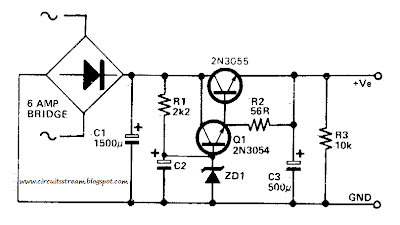
How to build a low ripple power supply circuit diagram. This simple low ripple power supply circuit diagram may be used where a high current is required with a low ripple voltage (such as in a high powered class AB amplifier when high quality reproduction is necessary) , Ql, Q2, and R2 may be regarded as a power darlington transistor.

ZDl and Rl provide a reference voltage at the base of Ql. ZDl should be chosen thus: ZDl = Von-1. C2 can be chosen for the degree of smoothness as its value is effectively multiplied by the combined gains of Q1/Q2, if 100 µF is chosen for C2, assuming minimum hfe for Ql and Q2, C = 100 x 15(Q1) x 25(Q2) = 37,000 µf.


Low Ripple Power Supply Circuit Diagram

Low Ripple Power Supply Circuit Diagram

Read More..

Friday, December 27, 2013

Build a Isolated 15V To 2500V Power Supply Circuit Diagram

Build a Isolated 15V To 2500V Power Supply Circuit Diagram. A dc-dc converter using a 74HC04 drives Tl. Tl is a ferrite-core transformer using a Fair-Rite, Inc. P/N 5975000201 (uo + 5000) and has a 7-turn primary and a 25-turn secondary. Kynar, #30 wirewrap wire is used. With Tl, the circuit isolation is good to 2500 V.

Isolated 15V To 2500V Power Supply Circuit Diagram

Isolated 15V To 2500V Power Supply Circuit Diagram

Read More..

Ground free DVM Module Supply from 5 V

The majority of hand-held digital volt meters use an LCD screen and are powered from a nine volt battery. Inside is most probably an ICL7106 chip (or something compatible). This takes care of measuring the input and driving the LCD. This IC is very popular and can be found in other laboratory and homebrew equipment where it offers a simple solution for both measuring current/voltage and driving the display.

So far so good, there is how-ever one feature of this device which needs careful consideration. The power supply to the chip (both the positive and negative connection) must not have any direct connection to either of the two measuring input terminals. It requires floating supplies. This is not a problem for battery powered equipment but needs more thought when the ICL7106 is fitted into mains powered equipment.

Ground-free DVM Module Supply from 5 V Circuit Diagram :

Ground-free DVM Module Supply from 5 V-Circuit Daigram

The simplest, most expensive solution is to use two independent power supplies in the equipment. A battery could also be used as an isolated supply but in a mains powered device it would seem a bit out of place and inconvenient.

In this case the term ‘floating supplies’ means that it is possible to have two separate DC levels. This level of isolation can be achieved with capacitors to separate the two DC supplies. Back in 2003 we published a circuit in the July/August edition of Elektor (circuit number 75) which used a NE555 IC. Unfortunately this design required a supply voltage upwards of 10 V. If the DVM module is fitted to equipment which only uses a 5 V supply (as is often the case) the circuit will not be of much use.The author has solved the problem by modifying the original circuit, using a hex Schmitt trigger inverter type 74HC14N instead of the NE555. One of the inverters generates a square wave of about 75 KHz. The remaining five inverters are wired in parallel to pro-vide more output drive current for the voltage multiplier stage.

DC isolation is provided by capacitors C2 and C3. A classic voltage multiplier configuration is made up of capacitors and diodes. The circuit generates an output of around 8.5 V at a load current of 1 mA. This is sufficient to power the DVM chip. The 5 V supply for the circuit must be stabilised.

The values of the input voltage divider resistors R2 and R3 are independent of the chip’s power supply and must be selected according to the desired measurement range.

Source :  http://www.ecircuitslab.com/2012/09/ground-free-dvm-module-supply-from-5-v.html
Read More..

Wednesday, December 25, 2013

Bipolar Power supply for Battery Instruments Circuits Diagram

Bipolar Power supply for Battery Instruments Circuits Diagram. To generate regulated ± 5-V supplies from a pair of dry batteries, the circuit of Fig. 1 is commonly used. In order to give protection from inadvertent reverse connection of a battery, a diode in series with each battery would produce an unacceptable voltage drop. The more effective approach is to fit diodes Dl and D2 as shown in Fig. 2, in parallel with each battery. 

When the supply is switched off, there is the risk of a reverse bias being applied across the regulators, if there is significant inductance or capacitance in the load circuit.Diodes across the regulators prevent damage. When the power supply is switched on, the two switches do not act in unison. There is a probability that one or the other regulators will be latched hard off by the other. To prevent this, D3 and D4 are Zener diodes so that ± 5-V rails are pulled up by the batteries until the regulators establish the correct levels.

Bipolar Power supply for Battery Instruments Circuits Diagram

Bipolar Power supply for Battery Instruments Circuits Diagram

Read More..

Tuesday, December 24, 2013

Laser Power Supply

If you have ever worked with lasers, you know how fun and interesting it can be, you also know how expensive it can be. The high voltage power supplies for the laser tubes are often more expensive then the tubes themselves. This supply can be built with common parts, most of which you probably already have in your junk box. The secret is the transformer used. It is a common 9V 1A unit, connected backwards for step up.

Parts


Part          

Total Qty.

Description

          
R1   110 Ohm 10W Or Greater Resistor
R2   1Ballast Resistor, See "Notes"
D1, D2, D3   31N4007 Silicon Diode
C1, C2, C3   30.1 uF 2000V Capacitor
T1   19V 1A Transformer
S1   1115V 2A SPST Switch
MISC   1Case, Wire, Binding Posts (for output), Line Cord

Notes

  • T1 is an ordinary 9V 1A transformer connected backwards for step up.
  • R1 MUST be installed on a LARGE heatsink. A good heatsink is the metal case the supply is built in.
  • R2 Protects the laser tube from excess current. It should be soldered directly to the anode terminal on the tube. To find R2, start with a 500K 10W resistor and work down until the tube lights and remains stable.
  • If you have trouble with the tube not starting easily, use a longer anode lead that is wrapped around the tube.
  • Depending on the transformer you use, the circuit may or may not work. I cannot guarantee the operation of this circuit. Build at your own risk. Some transformers contain very few secondary windings which will quickly saturate the core and basically act like a direct short. The more secondary windings (that is, primary in this circuit) the better.
Read More..

LM317 VARIABLE POWER SUPPLY Circuit Diagram

A truly timeless circuit. LM317 is a versatile and highly efficient 1.2-37V voltage regulator that can provide up to 1.5A of current with a large heat sink. Its ideal for just about any application. This was my first workbench power supply and I still use it.

 LM317 VARIABLE POWER SUPPLY Circuit Diagram

LM317 VARIABLE POWER SUPPLY Circuit Diagram


Since LM317 is protected against short-circuit, no fuse is necessary. Thanks to automatic thermal shutdown, it will turn off if heating excessively. All in all, a very powerful (and affordable!) package, indeed.

Although LM317 is capable of delivering up to 37V, the circuit pictured here is limited to 25V for the sake of safety and simplicity. Any higher output voltage would require additional components and a larger heat sink.
Make sure that the input voltage is at least a couple of Volts higher than the desired output. Its ok to use a trimmer if youre building a fixed-voltage supply.

Possible uses:
Variable workbench power supply, fixed-voltage supply... Just about any possible application when no more than 1.5A is necessary.
Read More..

Sunday, December 22, 2013

Fixed Voltage Power Supply

The fixed voltage power supply is useful in applications where an adjustable output is not required. This supply is simple, but very flexable as the voltage it outputs is dependant only on the regulator and transformer you choose. The maximum output current is 1.5A.

Fixed Voltage Power Supply Circuits diagram :

  Fixed Voltage Power Supply-Circuit diagram

Parts :

Part    Total     Description

C1           1       2200uF 35V Electrolytic Capacitor

C2, C4     2       0.1uF Ceramic Disc Capacitor

C3           3       10uF 35V Electrolytic Capacitor

D1, D2    1        1N4007 Silicon Diode

BR1        1        2A 30V Bridge Rectifier

U1          1        Regulator (See Notes)

T1          1        Transformer (See Notes)

S1          1        SPST 2 Amp Switch

F1          1        2A 250V Fuse and Holder 

Misc      1        Heatsink For U1, Line Cord, Case, Wire


Notes :

  1. Since this project operates from 120 (or 220, or 240, etc.) volts AC, it MUST be built inside a case.
  2. U1 will reauire a heatsink.
  3. You will need to choose T1 and U1 to match the voltage you want. Use the table below as a reference.
Read More..

Thursday, December 19, 2013

Simple 1 5V Supply For Zn416E Circuits Diagram

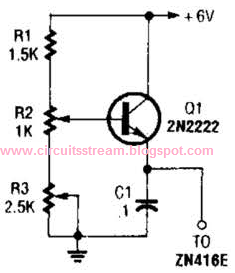
This regulator can be used with a +6-V source to supply ZN416E low-voltage TRF radio-receiver IC the necessary +1.5 V. R3 sets output voltage.


Simple +1.5V Supply For Zn416E Circuits Diagram

Simple +1.5V Supply For Zn416E Circuits Diagram

Read More..

Wednesday, December 18, 2013

Simple split power supply circuit Diagram

This circuit utilizes the quasi-complementary output stage of the popular LM380 audio power IC. The device is internally biased so that with no input the output is held midway between the supply rails Rl, which should be initially set to mid-travel, is used to nullify any inbalance in the output. 

Regulation of Vout depends upon the circuit feeding the LM380, but positive and negative outputs will track accurately irrespective of input regulation and unbalanced loads. 

The free-air dissipation is a little over 1 watt, and so extra cooling: may be required. The device is fully protected and will go into thermal shutdown if its rated dissipation is exceeded. Current limiting occurs if the output current exceeds 1 A. The input voltage should not exceed 20 V.

Simple split power supply circuit Diagram

Simple split power supply circuit Diagram

Read More..

Wednesday, October 9, 2013

Short Circuit Protection For Balanced Supply Rails

This circuit was designed to protect a dual rail power supply from shorts across the two rails. It uses an optocoupler to monitor each supply rail, with the internal LEDs powered from ZD2 and ZD3 and the associated resistors. While the LEDs are on, the optocouplers internal transistors are both turned on which ensures that transistor Q1 is on and relay RLY1 is energised. If either rail is short-circuited, the associated optocoupler is turned off, robbing Q1 of base current and the relay then drops out to disconnect the supply rails. Operation is restored by pressing the reset button. The value of ZD1 and the associated resistor should be chosen to suit the supply and relay coil voltages.

Short circuit protection for balanced supply rails circuit schematic
Read More..

Tuesday, October 8, 2013

Dual Opamp Buffered Power Supply

There will be instances where the currents from each supply will be unequal. Where this is the case, the resistor divider is not sufficient, and the +ve and -ve voltages will be unequal. By using a cheap opamp (such as a uA741), a DC imbalance between supplies of up to about 15mA will not cause a problem. However, we can do better with a dual opamp (which will cost the same or less anyway), and increase the capability for up to about 30mA of difference between the two supplies.
Dual Opamp Buffered Power Supply
Read More..

Wednesday, April 3, 2013

Protectors Circuit on SMPS power supply


The simplest example SMPS which still uses 3 transistors (C3807, A1015 and power transistors) classic problem that often occurs is: - Problem in the feedback circuit can cause the output voltage B + over so that it can endanger the aircraft as a whole. For example elco erupted, pcb burnt burnt by over-heated, horizontal transistor short.

- Problem on feedback circuits may cause power regulator transistor is damaged due to over current transistor (eg, due to the 47k resistor transistor circuit on the secondary error detector value is delayed).
- If the input ac voltage drops can cause the power regulator transistor is damaged, due to over current transistor If the secondary there is a power transistor short can cause damage over current regulator.
- Protectors are designed to make the SMPS SMPS "reliable will not be damaged" if there are things that go wrong as mentioned above. 

Switching Mode Power Supply protect Circuit
SMPS Circuit

SMPS circuit using IC systems generally are designed with a surge protector, which include:
  • Over voltage protector (OVP)
  • Over current protector (OCP)
  • Over load protector
  • Short circuit protector
  • Over temperature protector

Read More..