Showing posts with label voltage. Show all posts

Thursday, December 26, 2013

3V Low Battery Voltage Flasher

Many battery powered devices use two AA alkaline cells.  Often you will not know when it is time to replace the batteries until the device powered by them actually stops operating.  The hobby circuit below can be connected to a 3v battery, to give you some warning when the battery is nearing its end of life. It will flash a LED when the battery voltage drops to about 2.4 volts.

Circuit Project:3v Low Battery Voltage Flasher Circuit

The electronic circuit draws only 1ua of current in standby mode and jumps to only 20ua when flashing, so it can safely be included without depleting the battery energy. A voltage detector IC from Panasonic (Microchip also makes similar devices) is used to monitor the battery voltage. The device’s open drain output swings low, when the battery voltage is below 2.4 to 2.5 volts. This action turns on the two transistor oscillator circuit, which drives the LED with short current pulses lasting only 2ms.
Read More..

Wednesday, December 25, 2013

DC or AC Voltage Indicator

Detects 1.8 to 230 Volts DC or AC, Minimum parts counting

This circuit is not a novelty, but it proved so useful, simple and cheap that it is worth building. When the positive (Red) probe is connected to a DC positive voltage and the Black probe to the negative, the Red LED will illuminate. Reversing polarities the Green LED will illuminate. Connecting the probes to an AC source both LEDs will go on.

The bulb limits the LEDs current to 40mA @ 220V AC and its filament starts illuminating from about 30V, shining more brightly as voltage increases. Therefore, due to the bulb filament behavior, any voltage in the 1.8 to 230V range can be detected without changing component values.

Circuit diagram:


DC or AC Voltage Indicator Circuit Diagram

Parts:

P1 = Red Probe
P2 = Black Probe
D1 = 5 or 3mm. Red LED
D2 = 5 or 3mm. Green LED
LP = 1220V 6W Filament Lamp Bulb

Note:
  • A two colors LED (Red and Green) can be used in place of D1 & D2.
Source: Red Free Circuit Design
Read More..

Sunday, December 22, 2013

Fixed Voltage Power Supply

The fixed voltage power supply is useful in applications where an adjustable output is not required. This supply is simple, but very flexable as the voltage it outputs is dependant only on the regulator and transformer you choose. The maximum output current is 1.5A.

Fixed Voltage Power Supply Circuits diagram :

  Fixed Voltage Power Supply-Circuit diagram

Parts :

Part    Total     Description

C1           1       2200uF 35V Electrolytic Capacitor

C2, C4     2       0.1uF Ceramic Disc Capacitor

C3           3       10uF 35V Electrolytic Capacitor

D1, D2    1        1N4007 Silicon Diode

BR1        1        2A 30V Bridge Rectifier

U1          1        Regulator (See Notes)

T1          1        Transformer (See Notes)

S1          1        SPST 2 Amp Switch

F1          1        2A 250V Fuse and Holder 

Misc      1        Heatsink For U1, Line Cord, Case, Wire


Notes :

  1. Since this project operates from 120 (or 220, or 240, etc.) volts AC, it MUST be built inside a case.
  2. U1 will reauire a heatsink.
  3. You will need to choose T1 and U1 to match the voltage you want. Use the table below as a reference.
Read More..

Saturday, December 21, 2013

Voltage Inverter Using Switch Mode Regulator

This circuit uses a step-up switch-mode regulator, which is usually used to produce a positive supply, to generate a regulated negative output voltage. The device used here is the MIC4680 from Micrel (www.micrel.com), but the idea would of course work with similar regulators from other manufacturers. Because of coil L1, which performs the voltage conversion by the intermediate storage of energy in the form of a magnetic field, the output is effectively isolated from the input. We can therefore connect the right-hand side of L1 to ground rather than to the positive output without causing a large current to flow. Then we connect the ground pin of the regulator IC and all the components connected to it as the negative voltage output, isolated from ground.

Voltage Inverter Using Switch-Mode Regulator

The components on the output side of the regulator are connected as usual: flywheel diode D1, coil L1 and the voltage divider formed by R1 and R2. These last two components set the output voltage, according to a formula given in the data sheet. Example component values for the MIC4680 used here are given in the table. The input voltage should lie within the permitted range for the regulator used, and must in any case be at least as great in magnitude as the desired output voltage (here +5 V or +12 V), so that the step-down regulation technique can wor.

Voltage Inverter Using Switch-Mode Regulator Table
It is important to take care when building this circuit to mount the regulator using an insulator, since generally the GND pin of the device is connected to the heatsink tab. Also, the ON/OFF control input cannot be driven using a normal logic signal, since the regulator’s ground reference is the output voltage rather than ground itself. If the ON/OFF function is required, a level shifter or optocoupler must be used.

Source: http://www.ecircuitslab.com/2011/06/voltage-inverter-using-switch-mode.html 
Read More..

Friday, December 20, 2013

Voltage Converter Circuit Diagram

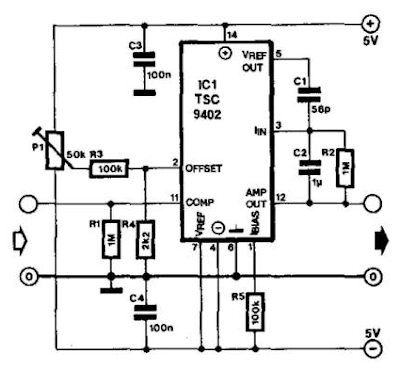
Teledyne Semiconductor`s Type TSC9402 is a versatile IC. Not only can it convert voltage into frequency, but also frequency into voltage. It is thus eminently suitable for use in an add-on unit for measuring frequencies with a multimeter. Only a few additional components are required for this.. Just one calibration point sets the center of the measuring range (or of that part of the range that is used most frequently). 

The frequency-proportional direct voltage at the output (pin 12—amp out) contains interference pulses at levels up to 0.7 V. If these have an adverse effect on the multimeter, they can be suppressed with the aid of a simple RC network. 

The output voltage, U0, is calculated by: tfo=C/rei(Ci + 12 pF) R2fm Because the internal capacitance often has a greater value than the 12 pF taken here, the formula does not yield an absolute value. The circuit has a frequency range of dc to 10 kHz. At 10 kHz, the formula gives a value of 3.4 V. The circuit draws a current of not more than 1 mA.

Voltage Converter Circuit Diagram

Voltage Converter Circuit Diagram

Read More..

Wednesday, December 18, 2013

Build a Long Line Ir Drop Voltage Recovery Circuit Diagram

How to Build a Long Line Ir Drop Voltage Recovery Circuit Diagram? This Simple Long Line Ir Drop Voltage Recovery Circuit Diagram provides a unique solution to a common system-level power distribution problem: When the supply voltage to a remote board must traverse a long cable, the voltage at the end of the line sometimes drops to unacceptable levels. 

This + 5-V/ + 5-V converter addresses this by taking the reduced voltage at the end of the supply line and boosting it back to + 5 V. This can be especially useful in remote display devices, such as some point-of-sale (POS) terminals, where several meters of cable could separate the terminal from the readout.

Long Line Ir Drop Voltage Recovery Circuit Diagram

Build a Long Line Ir Drop Voltage Recovery Circuit Diagram

Read More..

Wednesday, October 2, 2013

Buck Boost Voltage Converter

Sometimes it is desired to power a circuit from a battery where the required supply voltage lies within the discharge curve of the battery. If the battery is new, the circuit receives a higher voltage than required, whereas if the battery is towards the end of its life, the voltage will not be high enough. This is where the new LTC 3440 buck/boost voltage converter from Linear Technology (www.linear.com) can help. The switching regulator in Figure 1 converts an input voltage in the range +2.7 V to +4.5 V into an output voltage in the range +2.5 V to +5.5 V using one tiny coil.

Buck-Boost Voltage Converter circuit schematic

The level of the output voltage is set by the voltage divider formed by R2 and R3. The device switches as necessary between step-up (or ‘boost’) operation when Vin is less than Vout , and step-down (or ‘buck’) operation when Vin is greater than Vout. The maximum available output current is 600mA. The IC contains four MOSFET switches (Figure 2) which can connect the input side of coil L1 either to Vin or to ground, and the output side of L1 either to the output voltage or to ground. In step-up operation switch A is permanently on and switch B permanently off. Switches C and D close alternately, storing energy from the input in the inductor and then releasing it into the output to create an output voltage higher than the input voltage.

Buck-Boost Voltage Converter circuit schematic

In step-down operation switch D is permanently closed and switch C permanently open. Switches A and B close alternately and so create a lower voltage at Vout in proportion to the mark-space ratio of the switch ing signal. L1, together with the output capacitor, form a low-pass filter. If the input and output voltages are approximately the same, the IC switches into a pulse-width modulation mode using all four switches. Resistor R1 sets the switching frequency of the IC, which with the given value is around 1.2 MHz. This allows coil L1 to be very small. A suitable type is the DT1608C-103 from Coilcraft (www.coilcraft.com).

The IC can be shut down using the SHDN/SS input. A ‘soft start’ function can also be implemented by applying a slowly-rising voltage to this pin using an RC network. The MODE pin allows the selection of fixed-frequency operation (MODE connected to ground) or burst mode operation (MODE=Vin). The latter offers higher efficiency (of between 70% and 80%) at currents below 10 mA. At currents of around 100mA the efficiency rises to over 90 %. A further increase in efficiency can be obtained by fitting the two Schottky diodes shown dotted in the circuit diagram. These operate during the brief period when both active switches are open (break-before-make operation).
Read More..

Monday, September 30, 2013

High Current Low Dropout Voltage Regulator

This circuit was designed to allow a laptop computer to be powered from a solar power setup. The computer requires 12V at 3.3A. The circuit is a linear regulator with Mosfet Q4 as the series pass device. A 100kO resistor provides Q4 with a positive gate-source voltage. Any tendency for the output voltage to exceed ZD1s voltage causes Q2 to turn on. This turns on Q3 which reduces Q4s gate voltage and thus reduces the output voltage. Note that Q2s base-emitter voltage stabilizes at about 0.35V. This combined with the zener voltage gives an output of 12.4V. If a more precise output is required, first select ZD1 so that its voltage rating is at least 0.4V less than the required output voltage.

High current low-dropout regulator circuit schematic

You can then "trim" to the required output voltage by installing a resistor in series with ZD1. Q2s base-emitter voltage and the 680W base resistor set the current through ZD1 to 0.5mA. This means that the output voltage will be boosted by 0.1V for each 200O of resistance in series with ZD1. Zener diode ZD2 ensures that Q4s maximum rated gate-source voltage is not exceeded. Mosfet Q1 provides reverse polarity protection. Note that Q4 requires a heatsink since it will dissipate about 10W under worst-case conditions. No heatsink is required for Q1. At 3.3A, the regulator reduces the output voltage by just 0.2V. This can be further reduced by paralleling Q1 & Q4 with additional Mosfets.
Read More..

Sunday, September 29, 2013

Fast Voltage Driven Current Source

The current source in the diagram, which react very fast to changes in the input signal, may be used, for instance, in certain measurements. Differential amplifier IC1 ensures that the potential across R2 is equal to the input voltage: Iout =Uin/R2. The bandwidth, B, is given by B=R2 f /RL, where f=80 MHz, and the load impedance RL≥ R2 (both in ohms). The input is terminated into R1 to give the usual 50Ω impedance required by measuring instruments. At the same time, this resistor sets the d.c. operating point. If the link to the driving signal source is short and d.c. coupled, R1 may be omitted. The peak voltage between pins 1 and 2 of the IC is limited to 2.1 V to prevent too large a current at the output. Therefore, the peak output current is 2.1/100=21 mA.
Read More..

Saturday, September 21, 2013

Voltage Levels Control Relays

This circuit proves that microcoprocessors, PCs and the latest ultra-accurate DACs are overkill when it comes to controlling four relays in sequence in response to arising control voltage in the range 2.4 V –12 V. By using equal resistors in ladder network R1-R5, equal intervals are created between the voltages that switch on the relays in sequence. Each resistors drops 1/5th of the supply voltage or 2.4 V in this case, so we get +2.4 V = Re1, +4.8 V = Re2, +7.2 V = Re3, +9.6 V = Re4. Obviously, these switching levels vary along with the supply voltage, hence the need to employ a stabilised power supply. Looking at the lowest level switching stage, when the control voltage exceeds 2.4 V, IC1 will flip its output to (nearly) the supply level. The resulting current sent into the base of T1 is limited to about 1 mA by R6. With T1 driven hard, relay Re1 is energised by the collector current. Because the BC548 has a maximum collector current spec of 100 mA, the relay coil resistance must not be smaller than 120 ohms.

Voltage Levels Control RelaysNearly all current consumed by the circuit goes on account of the relay coils, so depending on your relays a pretty hefty power supply of up to 500mA may be required. When dimensioning the ladder network to create the desired switching levels, it is good to remember that the 741 will not operate very well with input voltages below 1.5V or above 10.5V, while voltage levels outside the supply range (i.e., negative or above +12V) are out of the question. If you do need a switching level in the range 0-1.5V, consider using an LM324, which contains four opamps in one package. For the high side of the range (10.5 to 12 V), a TL084 or a ‘rail-to-rail’ opamp like the TS924 is required. However, the TS924 cannot be used with supply voltages above 12 V.
Read More..

Thursday, April 11, 2013

High Voltage Generator

This high voltage generator was designed  with the aim of testing the electrical break-down protection used on the railways. These  protection measures are used to ensure that  any external metal parts will never be at a  high voltage. If that were about to happen,  a very large current would flow (in the order  of kilo-amps), which causes the protection  to operate, creating a short circuit to ground effectively earthing the metal parts. This hap-pens when, for example, a lightning strike hits  the overhead line (or their supports) on the  railways. 

This generator generates a high voltage of  1,000 V, but with an output current that is limited to few milliamps. This permits the electrical breakdown protection to be tested with-out it going into a short circuit state. The circuit uses common parts throughout: a  TL494 pulse-width modulator, several FETs or  bipolar switching transistors, a simple 1.4 VA  mains transformer and a discrete voltage multiplier. P1 is used to set the maximum current  and P2 sets the output voltage. 

Circuit diagram :
High Voltage Generator-Circuit Diagram
High Voltage Generator Circuit Diagram

The use of a voltage multiplier has the advantage that the working voltage of the smoothing capacitors can be lower, which makes them easier to obtain. The TL494 was chosen  because it can still operate at a voltage of  about 7 V, which means it can keep on working even when the batteries are nearly empty.  The power is provided by six C-type batteries, which keeps the total weight at a reason-able level. 

The 2x4 V secondary of AC power transformer  (Tr1) is used back to front. It does mean that  the 4 V winding has double the rated voltage  across it, but that is acceptable because the  frequency is a lot higher (several kilo-Hertz)  than the 50 Hz (60 Hz) the transformer is  designed for. The final version also includes a display of the  output voltage so that the breakdown volt-age can be read. 

From a historical perspective there follows a  bit of background information. In the past a different system was worked  out. Every high-voltage support post has a  protection system, and it isn’t clear when  the protection had operated and went into  a short-circuit state due to a large current  discharge. 

Since very large currents were involved, a certain Mr. Van Ark figured out a solution for this.  He used a glass tube filled with a liquid containing a red pigment and a metal ball. When  a large current discharge occurred the metal  ball shot up due to the strong magnetic field,  which caused the pigment to mix with the liquid. This could be seen for a good 24 hours after the event. After a thunder storm it was  easy to see where a discharge current took  place: one only had to walk past the tubes  and have a good look at them. 

Unfortunately, things didn’t work out as  expected. Since it often took a very long  time before a discharge occurred, the pigment settled down too much. When a dis-charge finally did occur the pigment no  longer mixed with the liquid and nothing was  visible. This system was therefore sidelined,  but it found its place in the (railway) history  books as the ‘balls of Van Ark’.
 
 
Streampowers
Read More..

Saturday, April 6, 2013

Simple Voltage Amplifier

Voltage amplifier is used to strengthen the input voltage. Voltage gain is the ratio of output voltage with input voltage. Where can we set the gain. Did this voltage amplifier applications? Alredy understand , Voltage amplifier can be used before the filter and power amplifier between the input signal and speaker. Remember again telecommunication engineering materials where the voltage amplifier is represented as a repeater in the process of data transmission.

The first thing to be done before designing the amplifier voltage gain is desired is to determine because the voltage gain is the main purpose of the voltage amplifier. By the way, the voltage amplifier is an amplifier Class A. Then determine the base sequence that is used along with transistors. In the amplifier voltage, output current (collector) is not so necessary so that the collector current labored as small as possible. All to save energy consumed. So there is no special requirement on the transistor voltage amplifier, where the collector current is set at 1% of the maximum collector current. Beta transistors that are not so influential on the quality of the amplifier (let alone use a voltage divider circuit which is relatively stable against changes in beta). The values ​​of other components can be searched with the existing formula. 

Simple Voltage Amplifier

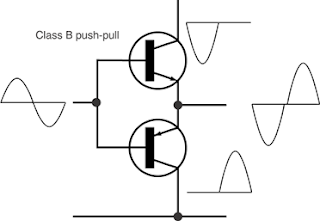
What about power amplifier? Aims to increase the power amplifier output signal power. In the course of this analog electronics, applied as a power amplifier on the speakers. At this power amplifier, the output voltage is set equal to the dc input voltage. While the current value of that changed. Does anyone know why the power amplifier, the voltage is fixed while the current is changed. I think changing the output flow is easier than changing the voltage output. And voltage range that can be applied is much smaller than the current range. Therefore it can be, the required current is very large so that in choosing a transistor must be adapted to current needs. If very large currents are needed at all, then it can be used Darlington transistor circuit. When I buy a transistor which has a large maximum collector current (about 1.5 A) appeared to form transistors is different from that so far I bought. At the center hole is used to heat sink. Heat sinks are used for fast component is not hot. By mounting the heat sink transistor then expand the surface so that heat more quickly thrown into the air. The price is relatively the same as a small power transistor. Btw, the actual power amplifier is a class B amplifier Class B amplifier is very efficient because the transistor will be active only when no signal input. Class B amplifier circuit consists of two identical transistors where each transistor is alternately brought in each half cycle. But there are drawbacks as well, the base emitter such as a diode that will be active when it has reached the forward bias voltage. So when the turn on off is not the same. Cause distortion of cross-over events. Form the output signal distortion due to cross-over is not expected that it needs considerable effort to overcome them. The solution is to arrange for the active transistor so that the need for constant base current (very small) even when it brought the transistor is not named as a class AB amplifier circuit.
Read More..