Showing posts with label inverter. Show all posts

Thursday, January 9, 2014

Simple 500W Inverter 12 Volt to 220 Volt Circuit Diagram

This is the Simple 500W Inverter 12 Volt to 220 Volt Circuit Diagram about the the inverter, because like working outdoors, or to backup storage to use when necessary. Most of this is circuit low power, which is not suitable for practical applications. My friends said that he would be about 500 Watt. It is a good size. Use with television receivers and light bulbs as well. When looking for circuit. I get headaches. 

500W Inverter 12 Volt to 220 Volt Circuit Diagram
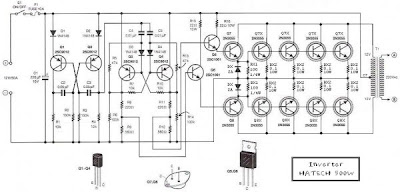
 
500W Inverter 12 Volt to 220 Volt Circuit Diagram

If you are a beginner or I can not buy expensive good quality circuits. Requires only one transistor. Or if you have free time. I want to build old circuit is alive again. This circuit will accommodate all your needs. It is a simple circuit. The same principle, I take battery voltage 12V to produce a oscillator about 100 Hz and pass to a two frequency divider circuit is only 50HZ. and drive a 10 ampere transformer with 10 x 2N3055 transistor in parallel. 

By a single transistor has 2A, when I use 10 transistors or 5 pairs of drive high current output. The complexity of circuit, but the principle is not it, and it is the number of transistors on a basic, easy to buy. You may be modified 100 watt power inverter To the size of transistors and transformers as well. 

Note:
If you think that This circuit is not good enough. For your work. It is hard to find equipment. You do not have it now. These circuits may be viewed below. It may be appropriate for you.


Source: leksound project

Read More..

Saturday, December 21, 2013

500W Low Cost 12V to 220V Inverter

Note :This Circuit is using high voltage that is lethal. Please take appropriate precautions
Using this circuit you can convert the 12V dc in to the 220V Ac. In this circuit 4047 is use to generate the square wave of 50hz and amplify the current and then amplify the voltage by using the step transformer. How to calculate transformer rating
500w_220v_inverter_corrected
The basic formula is P=VI and between input output of the transformer we have Power input = Power output
For example if we want a 220W output at 220V then we need 1A at the output. Then at the input we must have at least 18.3V at 12V because: 12V*18.3 = 220v*1
So you have to wind the step up transformer 12v to 220v but input winding must be capable to bear 20A.

Source :  http://www.ecircuitslab.com/2011/08/500w-low-cost-12v-to-220v-inverter.html
Read More..

Voltage Inverter Using Switch Mode Regulator

This circuit uses a step-up switch-mode regulator, which is usually used to produce a positive supply, to generate a regulated negative output voltage. The device used here is the MIC4680 from Micrel (www.micrel.com), but the idea would of course work with similar regulators from other manufacturers. Because of coil L1, which performs the voltage conversion by the intermediate storage of energy in the form of a magnetic field, the output is effectively isolated from the input. We can therefore connect the right-hand side of L1 to ground rather than to the positive output without causing a large current to flow. Then we connect the ground pin of the regulator IC and all the components connected to it as the negative voltage output, isolated from ground.

Voltage Inverter Using Switch-Mode Regulator

The components on the output side of the regulator are connected as usual: flywheel diode D1, coil L1 and the voltage divider formed by R1 and R2. These last two components set the output voltage, according to a formula given in the data sheet. Example component values for the MIC4680 used here are given in the table. The input voltage should lie within the permitted range for the regulator used, and must in any case be at least as great in magnitude as the desired output voltage (here +5 V or +12 V), so that the step-down regulation technique can wor.

Voltage Inverter Using Switch-Mode Regulator Table
It is important to take care when building this circuit to mount the regulator using an insulator, since generally the GND pin of the device is connected to the heatsink tab. Also, the ON/OFF control input cannot be driven using a normal logic signal, since the regulator’s ground reference is the output voltage rather than ground itself. If the ON/OFF function is required, a level shifter or optocoupler must be used.

Source: http://www.ecircuitslab.com/2011/06/voltage-inverter-using-switch-mode.html 
Read More..

Wednesday, September 11, 2013

500W 12 Volt to 220 Volt Inverter Circuit Diagram

 500W 12 Volt to 220 Volt Inverter Circuit Diagram

500W 12 Volt to 220 Volt Inverter

This is circuit Inverter 12VDC to 220V 50Hz 500W. It easy to make and low cost.
Read More..

Thursday, April 4, 2013

Inverter Circuit Using IC 4069 Discussed

Please read the previous post for the continuation...

Hi Aliman,
I am interested to follow the output stage exactly as given in your square wave design. I want you to include all the MOSFETs - NP as well as PN along with the buffer transistors and their base resistors.


The logic is very simple, if the output stage is responding and working well with the signals from the IC 4069, it should do the same with the signals from the 4017 ICs, after all both the designs are producing square waves (our design is producing a chopped one though.)

The voltages that you are getting are absolutely fine and the differences are too trivial to produce any effect on the circuit, moreover, very unlike the transistors, for MOSFETs its the voltage that matters and not the current and thats why the buffer transistors become very important and must be included.


I think it will be also important to include 10K resistors from the base of each buffer transistor to GROUND.

I wont be able to help you with the MOSFET types, as I myself am not quite knowledgeable with these devices, but the above modifications should hopefully set things in the right order.

Thanks and Best Regards.

Hi Swagatam, what if I replace the buffer transistor with one that has a higher collector current. Would that make a difference ?
 Also you mentioned adding 10K resistors, because there already is a 10K resistor from the 4069 to the base of the buffer transistor, so you want me to add another 10K from the Base to ground ,  correct ?
I dont have any PNP mosfets right now. But if this output stage works with the Square wave circuit , with some minor changes our PWM circuit should work also.
Sincerely Ali 

Hi Aliman,

I think we better stick to the tested design given below, so lets follow the circuit as given in your square wave design... we can always modify it once it starts working.

Thats correct... The 10K resistor from the base of the transistors to the ground will ensure that every time the diodes stop conducting the base receives a ground or a low logic level and switches OFF completely.

Yes..of-course, if it starts working then the issue gets over and we wont need to include the PNPs.

Best Regards.


Continued HERE,
Read More..