Showing posts with label flasher. Show all posts

Thursday, December 26, 2013

3V Low Battery Voltage Flasher

Many battery powered devices use two AA alkaline cells.  Often you will not know when it is time to replace the batteries until the device powered by them actually stops operating.  The hobby circuit below can be connected to a 3v battery, to give you some warning when the battery is nearing its end of life. It will flash a LED when the battery voltage drops to about 2.4 volts.

Circuit Project:3v Low Battery Voltage Flasher Circuit

The electronic circuit draws only 1ua of current in standby mode and jumps to only 20ua when flashing, so it can safely be included without depleting the battery energy. A voltage detector IC from Panasonic (Microchip also makes similar devices) is used to monitor the battery voltage. The device’s open drain output swings low, when the battery voltage is below 2.4 to 2.5 volts. This action turns on the two transistor oscillator circuit, which drives the LED with short current pulses lasting only 2ms.
Read More..

Friday, December 20, 2013

Simple 6V lamp Flasher Circuit Diagram


This is a simple lamp flasher circuit diagram.Here you  can use 6V lamp.I have added this for my bike.oh it is great at night I have used blue color bulb.


Note 


# Dont supply over 6V for this circuit 
# Build this circuit on a PCB
Read More..

230V Led Flasher Circuit using DIAC

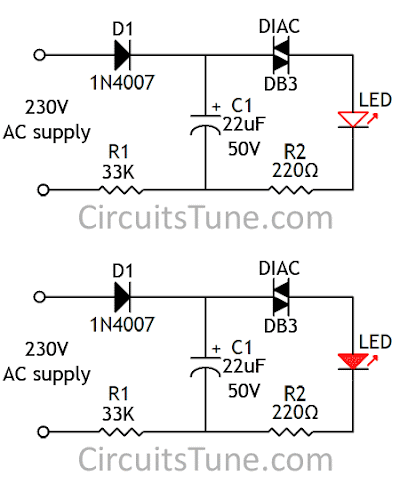
This is a very simple LED flasher circuit diagram that is powered from AC 230V mains. This Flasher can be used as a power indicator for the AC 230V mains supply. This circuit is made with few numbers of parts namely, a LED, two Resistors, one Capacitor, one Diode and one DIAC.  The DIAC act the main role to flashing the LED. DIAC is a bidirectional device. It conducts current only after its breakover voltage has been reached its threshold. Most DIACs break-over voltage is around 30 V.


230V Mains Power Indicator LED Flasher Circuit Diagram


230V Led Flasher
Fig: Circuit Diagram of 230V Led Flasher

When mains is connect to the circuit, the Capacitor(C1) starts charging through Diode(D1) and Resistor(R1). When the voltage on the capacitor reached the DIAC’s threshold voltage, the DIAC get turn on. And LED gets Lights(flash). At the same time Capacitor(C1) goes discharges and breakover voltage of DIAC also decrease and LED turns OFF. The on off time of the LED depends on the value of Capacitor(C1)  and Resistor(R1).
Note that the flashing time of the LED shown in the animating figure is not the exact timing of ON/OFF.
Read More..

Sunday, May 26, 2013

LED Flasher For the Christmas With NE555

I know now you are getting ready for your christmas.So I thought to give you a useful circuit.This is a LED flasher circuit .You can use this to decorate your christmas star or your crib.I have used here NE555 commen IC.this circuit works with 9v power supply.
Read More..