Showing posts with label transistor. Show all posts

Friday, December 27, 2013

Motorcycle Alarm With Transistor Circuit Diagram

This is a simple Motorcycle Alarm With Transistor Circuit Diagram. Its designed to work at 12-volts. But - if you change the relay for one with a 6-volt coil - itll protect your "Classic Bike". The standby current is virtually zero - so it wont drain your battery.

Motorcycle Alarm With Transistor Circuit Diagram

Motorcycle Alarm With Transistor Circuit Diagram

Any number of normally-open switches may be used. Fit the mercury switches so that they close when the steering is moved or when the bike is lifted off its side-stand or pushed forward off its centre-stand. Use micro-switches to protect removable panels and the lids of panniers etc. While at least one switch remains closed - the siren will sound.

About one minute after all of the switches have been opened again - the alarm will reset. How long it takes to switch off depends on the characteristics of the actual parts youve used. You can adjust the time to suit your requirements by changing the value of C1 and/or R3.

The circuit is designed to use an electronic Siren drawing 300 to 400mA. Its not usually a good idea to use the bikes own Horn because it can be easily located and disconnected. However, if you choose to use the Horn, remember that the alarm relay is too small to carry the necessary current. Connect the coil of a suitably rated relay to the Siren output - and use its contacts to sound the horn.

The circuit board and switches must be protected from the elements. Dampness or condensation will cause malfunction. Without its terminal blocks, the board is small. Ideally, you should try to find a siren with enough spare space inside to accommodate it. Fit a 1-amp in-line fuse as close as possible to the power source. This is Very Important. The fuse is there to protect the wiring - not the circuit board. Instead of using a key-switch you can use a hidden switch; or you could use the normally-closed contacts of a small relay. Wire the relay coil so that its energized while the ignition is on. Then every time you turn the ignition off - the alarm will set itself.

When its not sounding, the circuit uses virtually no current. This should make it useful in other circumstances. For example, powered by dry batteries and with the relay and siren voltages to suit, it could be fitted inside a computer or anything else thats in danger of being picked up and carried away. The low standby current and automatic reset means that for this sort of application an external on/off switch may not be necessary.

When you set the alarm - if one of the switches is closed - the siren will sound. This could cause annoyance late at night. A small modification will allow you to Monitor The State Of The Switches using LEDs. When the LEDs are all off - the switches are all open - and its safe to turn the alarm on.

Veroboard Layout
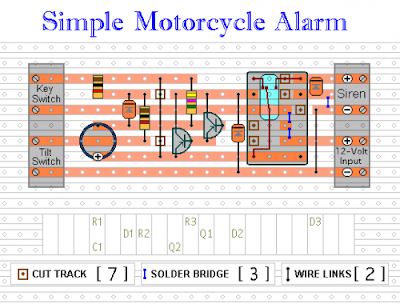
Veroboard Layout


Read More..

Tuesday, October 8, 2013

12 V AUDIO AMPLIFIER WITH TRANSISTOR ELECTRONIC DIAGRAM

12 V AUDIO AMPLIFIER WITH TRANSISTOR ELECTRONIC DIAGRAM

In use, R9 should be carefully adjusted to provide minimal audible signal cross-over distortion consistent with minimal measured quiescent current consumption; a good compromise is to set the quiescent current at about 10-15 mA.To measure this current, wire a DC current meter temporarily in series with the collector of Q3.

List Component

  • P1_____________10K Log.Potentiometer
  • R1,R2__________33K 1/4W Resistors
  • R3_____________33R 1/4W Resistor
  • R4_____________15K 1/4W Resistor
  • R5,R6___________1K 1/4W Resistors
  • R7____________680R 1/4W Resistor
  • R8____________120R 1/2W Resistor
  • R9____________100R 1/2W Trimmer Cermet
  • C1,C2__________10µF 63V Electrolytic Capacitors
  • C3____________100µF 25V Electrolytic Capacitor
  • C4,C7_________470µF 25V Electrolytic Capacitors
  • C5_____________47pF 63V Ceramic Capacitor
  • C6____________220nF 63V Polyester Capacitor
  • C8___________1000µF 25V Electrolytic Capacitor
  • D1___________1N4148 75V 150mA Diode
  • Q1____________BC560C 45V 100mA PNP Low noise High gain Transistor
  • Q2____________BC337 45V 800mA NPN Transistor
  • Q3____________TIP31A 60V 4A NPN Transistor
  • Q4 ___________TIP32A 60V 4A PNP Transistor
  • SW1___________SPST switch
Read More..

Sunday, September 29, 2013

Economical Transistor Radio

The schematic diagram shows an audio stage with a common-collector circuit. This does not damp the tuned circuit, but instead actually increases its response. This yields good sensitivity and selectivity. Due to the low supply voltage, the subsequent audio amplifier needs three transistor stages. The volume is adjusted using the potentiometer. This radio works well using an internal ferrite rod (around 1 cm diameter and 10 cm long) with a winding of around 50 turns of enameled copper wire. With a two-meter external wire aerial, you can receive even more stations. This radio is not only economical in terms of components, it also needs very little ‘juice’: since the current consumption is only 10mA, an alkaline AA cell will easily last for around 200 hours of operation.

Economical Transistor Radio circuit diagram
The specifications, very briefly stated, are:
  • medium-wave receiver with ferrite aerial
  • optional supplementary aerial
  • power supply 1.5 V/10 mA
  • 4 transistors
  • loudspeaker output
Read More..

Friday, September 27, 2013

One Transistor Radio

Here is a simple circuit for a one transistor Audion type radio powered by a 1.5 V battery. It employs a set of standard low-impedance headphones with the headphone socket wired so that the two sides are connected in series thus giving an impedance of 64 Ω. The supply to the circuit also passes through the headphones so that unplugging the headphones turns off the supply. Using an Audion configuration means that the single transistor performs both demodulation and amplification of the signal.

One Transistor Radio Circuit DiagramThe sensitivity of this receiver is such that a 2 m length of wire is all that is needed as an antenna. The tap on the antenna coil is at 1/5th of the total winding on the ferrite rod. For details of the antenna coil see the article Diode Radio for Low Impedance Headphones. This circuit is suitable for reception of all AM transmissions from long-wave through to shortwave.
Read More..