Friday, December 27, 2013

Build a Isolated 15V To 2500V Power Supply Circuit Diagram

Build a Isolated 15V To 2500V Power Supply Circuit Diagram. A dc-dc converter using a 74HC04 drives Tl. Tl is a ferrite-core transformer using a Fair-Rite, Inc. P/N 5975000201 (uo + 5000) and has a 7-turn primary and a 25-turn secondary. Kynar, #30 wirewrap wire is used. With Tl, the circuit isolation is good to 2500 V.

Isolated 15V To 2500V Power Supply Circuit Diagram

Isolated 15V To 2500V Power Supply Circuit Diagram

Read More..

Ground free DVM Module Supply from 5 V

The majority of hand-held digital volt meters use an LCD screen and are powered from a nine volt battery. Inside is most probably an ICL7106 chip (or something compatible). This takes care of measuring the input and driving the LCD. This IC is very popular and can be found in other laboratory and homebrew equipment where it offers a simple solution for both measuring current/voltage and driving the display.

So far so good, there is how-ever one feature of this device which needs careful consideration. The power supply to the chip (both the positive and negative connection) must not have any direct connection to either of the two measuring input terminals. It requires floating supplies. This is not a problem for battery powered equipment but needs more thought when the ICL7106 is fitted into mains powered equipment.

Ground-free DVM Module Supply from 5 V Circuit Diagram :

Ground-free DVM Module Supply from 5 V-Circuit Daigram

The simplest, most expensive solution is to use two independent power supplies in the equipment. A battery could also be used as an isolated supply but in a mains powered device it would seem a bit out of place and inconvenient.

In this case the term ‘floating supplies’ means that it is possible to have two separate DC levels. This level of isolation can be achieved with capacitors to separate the two DC supplies. Back in 2003 we published a circuit in the July/August edition of Elektor (circuit number 75) which used a NE555 IC. Unfortunately this design required a supply voltage upwards of 10 V. If the DVM module is fitted to equipment which only uses a 5 V supply (as is often the case) the circuit will not be of much use.The author has solved the problem by modifying the original circuit, using a hex Schmitt trigger inverter type 74HC14N instead of the NE555. One of the inverters generates a square wave of about 75 KHz. The remaining five inverters are wired in parallel to pro-vide more output drive current for the voltage multiplier stage.

DC isolation is provided by capacitors C2 and C3. A classic voltage multiplier configuration is made up of capacitors and diodes. The circuit generates an output of around 8.5 V at a load current of 1 mA. This is sufficient to power the DVM chip. The 5 V supply for the circuit must be stabilised.

The values of the input voltage divider resistors R2 and R3 are independent of the chip’s power supply and must be selected according to the desired measurement range.

Source :  http://www.ecircuitslab.com/2012/09/ground-free-dvm-module-supply-from-5-v.html
Read More..

Motorcycle Alarm With Transistor Circuit Diagram

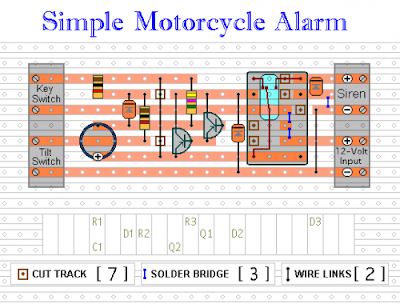
This is a simple Motorcycle Alarm With Transistor Circuit Diagram. Its designed to work at 12-volts. But - if you change the relay for one with a 6-volt coil - itll protect your "Classic Bike". The standby current is virtually zero - so it wont drain your battery.

Motorcycle Alarm With Transistor Circuit Diagram

Motorcycle Alarm With Transistor Circuit Diagram

Any number of normally-open switches may be used. Fit the mercury switches so that they close when the steering is moved or when the bike is lifted off its side-stand or pushed forward off its centre-stand. Use micro-switches to protect removable panels and the lids of panniers etc. While at least one switch remains closed - the siren will sound.

About one minute after all of the switches have been opened again - the alarm will reset. How long it takes to switch off depends on the characteristics of the actual parts youve used. You can adjust the time to suit your requirements by changing the value of C1 and/or R3.

The circuit is designed to use an electronic Siren drawing 300 to 400mA. Its not usually a good idea to use the bikes own Horn because it can be easily located and disconnected. However, if you choose to use the Horn, remember that the alarm relay is too small to carry the necessary current. Connect the coil of a suitably rated relay to the Siren output - and use its contacts to sound the horn.

The circuit board and switches must be protected from the elements. Dampness or condensation will cause malfunction. Without its terminal blocks, the board is small. Ideally, you should try to find a siren with enough spare space inside to accommodate it. Fit a 1-amp in-line fuse as close as possible to the power source. This is Very Important. The fuse is there to protect the wiring - not the circuit board. Instead of using a key-switch you can use a hidden switch; or you could use the normally-closed contacts of a small relay. Wire the relay coil so that its energized while the ignition is on. Then every time you turn the ignition off - the alarm will set itself.

When its not sounding, the circuit uses virtually no current. This should make it useful in other circumstances. For example, powered by dry batteries and with the relay and siren voltages to suit, it could be fitted inside a computer or anything else thats in danger of being picked up and carried away. The low standby current and automatic reset means that for this sort of application an external on/off switch may not be necessary.

When you set the alarm - if one of the switches is closed - the siren will sound. This could cause annoyance late at night. A small modification will allow you to Monitor The State Of The Switches using LEDs. When the LEDs are all off - the switches are all open - and its safe to turn the alarm on.

Veroboard Layout

Veroboard Layout


Read More..

Thursday, December 26, 2013

Latch Up Alarm Using Opto Coupler

The latch-up alarm described here is based on single IC NE555, configured as an astable multivibrator. The timing components are selected such that the oscillation frequency of the multivibrator lies within the audio range. Instead of a flip-flop stage, an opto-coupler (MCT2E) is used for latching of the alarm.  Under normal condition, pin 4 of IC1 is pulled to ground via resistor R2, and its output at pin 3 is held  ‘low’. When switch S1 is pressed momentarily, transistor T1 conducts to bring reset pin 4 of 555 to logic  ‘high’. As a result, IC1 is activated and the alarm starts to sound.
 
Latch-Up Alarm Using Opto-Coupler Circuit Diagram

Latch-Up Alarm Using Opto-Coupler Circuit-Diagram

 
Simultaneously, the LED inside opto-coupler glows and the phototransistor conducts. As a result, trigger transistor T1 gets base bias via phototransistor and resistor R6. The alarm sounds continuously until reset switch S2 is pressed. When switch S2 is pressed, transistor T1 is switched  ‘off’ to bring pin 4 of IC1 to logic ‘low’ and the alarm is disabled.


Source:   http://www.ecircuitslab.com/2012/01/latch-up-alarm-using-opto-coupler.html


Read More..

It is unnecessary for the customer to stop the use

It is unnecessary for the customer to stop the use of cell phone jammer .
There are some mobile phones which are having many advanced features and so their cost is high. However, you can find several cheap mobile phones available in the UK market online mobile phone shops give you the latest brands from the prominent manufacturers at a very competitive price offer. The worst of it is that others use it to send objective answers to those in the examination hall, which may not be correct at the end of the day. This can end the students career if caught, as exam malpractice is a punishable offense.
In the end, I had to fork out a sum of $200 to clean up the mould and to get the mobile phone functioning again some 3 months later, because by the time it was repaired, I was back in Australia and had to get a friend to retrieve it for me.
Now, the lesson of this experience is simple - Read the fine print of your warranty that comes with every purchase of your mobile phone.Just because what you buy is an established brand, never ever assume that its design is built to keep out the moisture or that it would not become mouldy inside, not even if it is a Sony. I was told it was standard policy to treat mouldy conditions within the mobile phone as a result of improper use of the mobile phone, rendering any warranty void.
While the mobile phone was a newer model, and I had always considered it an important part of my professional tools, there was never any case of mis-use of the mobile phone that could have allowed water to seep inside the mobile phone. If there was any mould, it would only have been the change of weather from the country of purchase and the country of use.
Let my experience be your guide, and pay attention to the fine print of your warranty so that you are sure whether mouldy conditions are covered under the warranty especially if you are going to use a mobile phone purchased overseas where there are different climatic conditions.
Avoid buying a lemon when you are shopping for a newer mobile phone. Visit your local Australian and New Zealand mobile phones online store Aussie Mobile Phones Store [http://aussie-mobilephones.reviewadvisors.info] for free resources and to view the latest in mobile phones for the Australian and New Zealand region. Updated daily, the website has a vast array of mobile phones on offer for the discerning user, and provides an online shopping experience with a difference.
Secondary school is a term used to describe an educational institution where the final stage of schooling, known as secondary education and usually compulsory up to a specified age, takes place. It follows elementary or primary education, and may be followed by university (tertiary) education.
Read More..

Cat and Dog Repeller

Nowadays, just about every house has an outside lamp with a motion sensor. Such a device eliminates the need to feel your way to the front door, and it apparently also scares away intruders. The only problem is that free-running dogs and cats in the neighborhood have little regard for such lamps and continue to deposit their excrement in the garden, once they have found a habitual location there for this purpose. This gave rise to the idea of connecting a sort of siren in parallel with the outside lamp to clearly advise dogs and cats that they are not welcome.

Naturally, it would be nice to avoid startling the entire neighborhood with this alarm signal. Here we can take advantage of the fact that dogs and cats have a significantly better sense of hearing than people. Not only are their ears more sensitive, they can also perceive significantly higher frequencies. With people, the upper limit is around 18 kHz, but dogs and cats can hear frequencies in excess of 20 kHz. We can take advantage of this by building a siren that emits a frequency just above 20 kHz.

Cat and Dog Repeller Circuit diagram :
Cat and Dog Repeller Circuit Diagram


This will scare off dogs and cats, but people will simply not hear it. All we need for this is an oscillator with an amplifier stage and a tweeter that can reproduce such high frequencies, such as a piezoelectric tweeter. The schematic diagram shows how easily this can be implemented. The power supply for the entire circuit is formed by the components up to and including C2. The 230-V leads are connected in parallel with the motion-sensor lamp. C1 and R1 provide capacitive coupling to reduce the 230 V to an acceptable voltage. 

A DC voltage of approximately 9.1 V is generated from this voltage using a bridge rectifier and D1, filtered and buffered by C2. The oscillator is built around R3, C3 and IC1a.The frequency of this oscillator is rather dependent on the specific characteristics of IC1, so the values shown here should be regarded as guidelines. If the oscillator frequency is too high, it can be reduced by increasing the value of R3 and/or C3.

If the frequency is too low (which means that the siren tone it is audible), the value of R3 and/or C3 should be increased. The square-wave signal from the oscillator is applied to the input of an H bridge composed of several Schmitt triggers in combination with the final output stages (T1–T4). This approach causes the peak-to-peak value of the square wave signal to be twice the supply voltage. As a result, a respectable 18 V is obtained across the piezoelectric tweeter, which is sufficient to produce a quite loud whistle tone. When building the circuit, you should bear in mind that it is directly powered from 230 V and not electrically isolated from the mains network.

It is thus necessary to avoid contact with all of the components when the circuit is in use. In practice, this means that the circuit must be fitted into a well-insulated, waterproof box. If you want to test the circuit, it is a good idea to first discharge C1 using a resistor, since it can hold a dangerous charge. You must also ensure that components F1, C1, R1 and B1 all have a mutual insulation separation of at least 6 mm!

Source : www.ecircuitslab.com/2011/05/cat-and-dog-repeller.html
Read More..

3V Low Battery Voltage Flasher

Many battery powered devices use two AA alkaline cells.  Often you will not know when it is time to replace the batteries until the device powered by them actually stops operating.  The hobby circuit below can be connected to a 3v battery, to give you some warning when the battery is nearing its end of life. It will flash a LED when the battery voltage drops to about 2.4 volts.

Circuit Project:3v Low Battery Voltage Flasher Circuit

The electronic circuit draws only 1ua of current in standby mode and jumps to only 20ua when flashing, so it can safely be included without depleting the battery energy. A voltage detector IC from Panasonic (Microchip also makes similar devices) is used to monitor the battery voltage. The device’s open drain output swings low, when the battery voltage is below 2.4 to 2.5 volts. This action turns on the two transistor oscillator circuit, which drives the LED with short current pulses lasting only 2ms.
Read More..